
Hospital Backup Generator Requirements: 10-Second Start, ATS and Redundancy
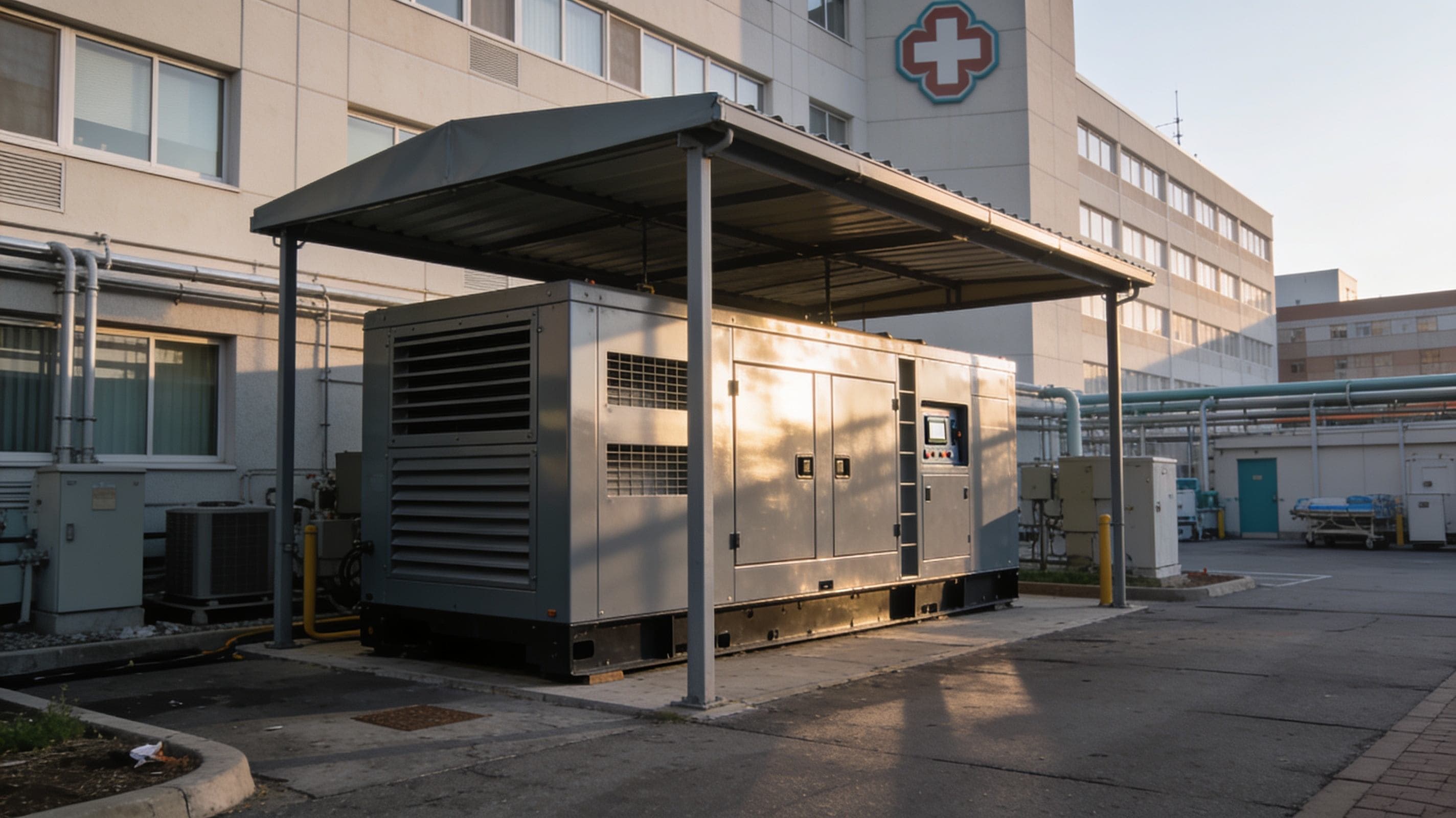
What a hospital or clinic standby set must do: reach rated load within the code window, carry life-safety loads through an ATS, and stay redundant enough that one fault does not darken a ward.
A hospital set is judged on the seconds after the grid fails, not on its catalogue kW. It must start, reach rated load and pick up life-safety circuits through an automatic transfer switch, then run them without a single point of failure. Size the essential load, not the whole building, and build in redundancy. Start from the diesel standby range and group loads through the ATS.
Four constraints a healthcare set must meet
Emergency power is a safety system, so the constraints are set by codes and by what a ward actually cannot lose. Four of them decide the specification.
- Start time. Most emergency codes require the set to reach rated load within a tight window after a grid failure, commonly around 10 seconds for life-safety loads, so the transfer is seamless to patients and equipment.
- Life-safety load priority. Theatres, intensive care, lifts, fire pumps and the cold chain must be served first and without interruption. Non-essential load is dropped or deferred, not allowed to starve the critical circuits.
- Redundancy. A single set with one fault path is a single point of failure. Larger sites use N+1 or paralleled sets so maintenance or a fault on one does not darken a ward.
- Fuel and testing. The set must run the required hours on site fuel, and it must be exercised and logged so it actually starts when called. A set that is never tested is a set that may not start.
Sizing step by step
Size the essential load the ATS will pick up, then add the largest motor start, then build in the redundancy the code and the site demand.
- 1List the essential load. Theatres, ICU, lifts, fire pumps, ventilation and cold chain in running kW, separated from comfort load you will not back up.
- 2Add the largest start. Chillers, pumps and lift motors have high starting current; the alternator and ATS must carry it without the voltage dropping below the equipment limit.
- 3Group through the ATS. Decide which circuits transfer on loss of grid and which wait or are dropped, so the set is never asked to carry more than it should.
- 4Apply the site. Altitude and heat still cut output; apply the same planning factors and keep margin for the motor starts on top of the derate.
- 5Build in redundancy. For a ward that cannot go dark, specify N+1 or paralleled sets so one can be serviced while the other carries the load.
Facility size and the band it needs
These are planning positions for the essential load only. A full-building backup is larger and is sized from the actual critical circuit list.
| Facility | Typical band | What drives it |
|---|---|---|
| Clinic or small hospital | 100 - 350 kW | Theatres, a few lifts, refrigeration |
| District hospital | 350 - 1200 kW | Multiple wards, ICU, fire pumps, chiller start |
| Large or teaching hospital | 1200 - 2000 kW | Redundant critical load across buildings |
| Campus with N+1 | 2000 kW & above | Paralleled sets, one down for service |
Which build a healthcare set needs
For a set that must start first time, the enclosure and controls matter as much as the engine. KINBOOST builds enclosed, sound-attenuated standby sets with automatic controls and remote alarm, because that is what a healthcare duty demands. A set is only as good as the load-bank test report it ships with, so we witness and log the run before dispatch. See the healthcare solutions page for the line-up.
- Automatic transfer, not manual. The ATS senses loss of grid and moves the critical load to the set without an operator in the building.
- Enclosed and attenuated. A hospital set often sits close to occupied space, so a rated dB(A) enclosure is normal rather than optional.
- Remote alarm and logging. Facilities teams need to see fuel, runtime, fault and test history from the building management system.
- Service access. The set must be reachable for the regular load-bank and function tests the code requires, without blocking the emergency path.
Questions buyers ask about healthcare sets
Frequently asked questions
Do I size the whole building or just the critical load?
Size the essential life-safety load the ATS will pick up, not the whole building. Comfort load is usually dropped on transfer, and backing it up only oversizes the set and the fuel tank.
What does the 10-second start actually mean?
It is the window, set by emergency codes such as NFPA 110 for Level 1 systems, within which the set must reach rated load after a grid failure. The ATS then transfers the critical circuits. Confirm the exact window your authority having jurisdiction requires.
Why N+1 instead of one larger set?
N+1 lets you take one set down for service or cover a fault without losing the backup. For wards that cannot go dark, that redundancy is usually worth more than the saving of a single set.
How often must the set be tested?
Emergency sets are exercised on a fixed schedule and the runs are logged, because a set that is never run may not start when called. The interval is set by the applicable code; build the access and logging into the specification from the start.
Does altitude derating still apply?
Yes. A hospital set on a high or hot site loses output like any other, and you still need margin for motor starts on top of the derate. Apply the same planning factors and confirm on the datasheet.
What should I send for a sized proposal?
The critical circuit schedule, the largest motor and its start method, required run time on site fuel, altitude and ambient, and the code your authority cites. Send it through the RFQ form and we return a sized, redundant proposal.