
Irrigation and Farm Generator Power: Seasonal Duty and Off-Grid Sizing
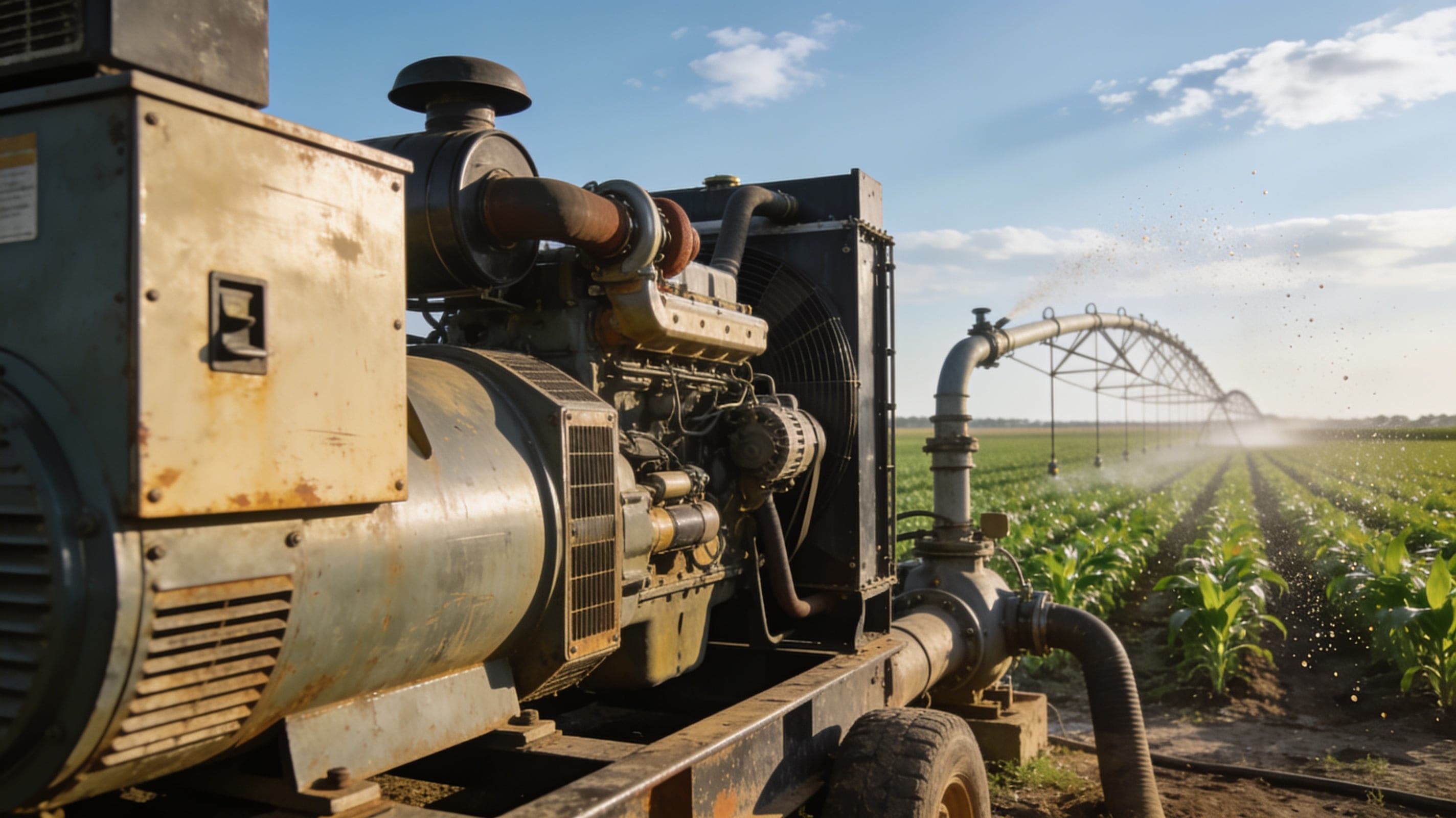
How to power irrigation and farm duty: size on the pump starting kVA, plan for a season of hard running with no grid, and keep the set in the lower to mid bands where most single pivots sit.
Most farms and irrigation schemes need a set that runs hard for a season, then sits, on a site with no grid and a big pump motor to start. Size on the pump starting kVA plus the running load, plan for dust and weather, and keep the set in the lower to mid bands where most single pivots sit. Start from the diesel range and confirm the derating before you commit a site.
Four constraints a farm and irrigation set faces
A farm set earns its keep in bursts and in hostile conditions. Four constraints decide the build more than the nameplate.
- Seasonal duty. The set may run 18 hours a day for six weeks at irrigation peak, then idle for months. Specify prime or continuous duty for the season, not a standby rating that assumes a few hundred hours a year.
- No grid, long cable. Many irrigation and remote farm sites have no utility supply, so the set is the only power. Cable runs are long and the pump motor start is the event that decides the alternator.
- Pump motor start. A centrifugal or submersible pump draws a hard starting current that can be several times the running load. The alternator and AVR must hold voltage through it, or the pump never reaches speed.
- Dust, weather and critters. Open fields mean dust, rain, vermin and tractor traffic. A weather-sealed, elevated, lockable set outlasts an open skid left in the field.
Sizing step by step
Work the pump first, then the rest, then the site. Do not size from the connected load and hope the motor starts.
- 1List the pump and the auxiliaries. Pump running kW, the start method (DOL, star-delta, soft start), plus lighting, control and any dairy or cold load.
- 2Add the starting kVA. The pump start usually sets the engine and alternator size, often well above the running total. State the start method in the enquiry so the AVR is sized for it.
- 3Add the seasonal peak. Grain drying or a second pivot in peak season adds load on top of irrigation; size for the worst week, not the average day.
- 4Apply the site. Open, often hot or high sites cut output as everywhere else. Use the same planning factors and link the derating to the derating worked example when the farm sits above 1,500 m.
- 5Pick the band and the form. Choose the open or weatherproof build in the band that covers the derated figure with margin, and keep it elevated and serviceable in the field.
Farm load and the band it lands in
These are planning positions, not a substitute for the load list. They show where each kind of farm duty usually falls in the range.
| Farm duty | Typical band | What drives it |
|---|---|---|
| Small drip or single pump | 20 - 100 kW | Modest pump plus lighting and control |
| Centre pivot or multiple pumps | 100 - 350 kW | One large pump start dominates |
| Dairy, cooling and sheds | 50 - 200 kW | Steady load plus a compressor start |
| Grain drying at harvest peak | 200 - 500 kW | Seasonal peak on top of irrigation |
Which build suits a farm site
For a set in a field, the enclosure and the start gear matter as much as the kW. KINBOOST builds weatherproof, elevated and auto-starting sets with pump-friendly alternators, because that is what an irrigation duty demands. See the farm and agriculture solutions page for the line-up.
- Weatherproof canopy or open skid on a skid base. Choose the enclosure for the season and the site; an open skid only where attended and sheltered.
- Pump-rated alternator and soft start. Size the alternator for the pump start and use a soft starter where the cable or the supply is weak.
- Elevated, drainable base. Keep the set clear of mud, vermin and flood, with a base tank sized for the irrigation shift.
- Auto-start for the season. A set that starts on demand and runs unattended through the watering window saves the labour the duty is meant to free up.
Questions buyers ask about farm sets
Frequently asked questions
Standby or prime rating for irrigation?
Prime or continuous, not standby. Irrigation runs for long hours across a season, and standby ratings assume only a few hundred hours a year. Size the duty for the peak weeks or the set will be over-rated on paper and under-powered in the field.
How do I size for a pump that starts hard?
The pump start, not the running kW, usually sets the alternator and engine. Give the start method and the running load, and have the alternator sized for the starting kVA so voltage holds through the start.
Does altitude or heat derating apply on a farm?
Yes, on high or hot sites, exactly as elsewhere. Apply the same planning factors and keep margin for the pump start on top of the derate, then confirm the curve on the engine datasheet.
Open skid or enclosed set in the field?
Enclosed where the set is exposed to dust, rain, vermin or theft; an open skid only where attended and sheltered. Weather and security usually decide before price does.
Can one set cover irrigation and grain drying?
Often yes if you size for the peak-season total, not the irrigation-only day. Grain drying adds load on top of irrigation, so size for the worst week and keep margin for a second shift.
What should I send for a sized proposal?
Pump running kW and start method, any dairy or drying load, site altitude and ambient, and whether the set must be mobile. Send it through the RFQ form and we return a sized, pump-rated proposal.