
Mining and Quarry Generator Sizing: Altitude Derating, Dust and Continuous Load
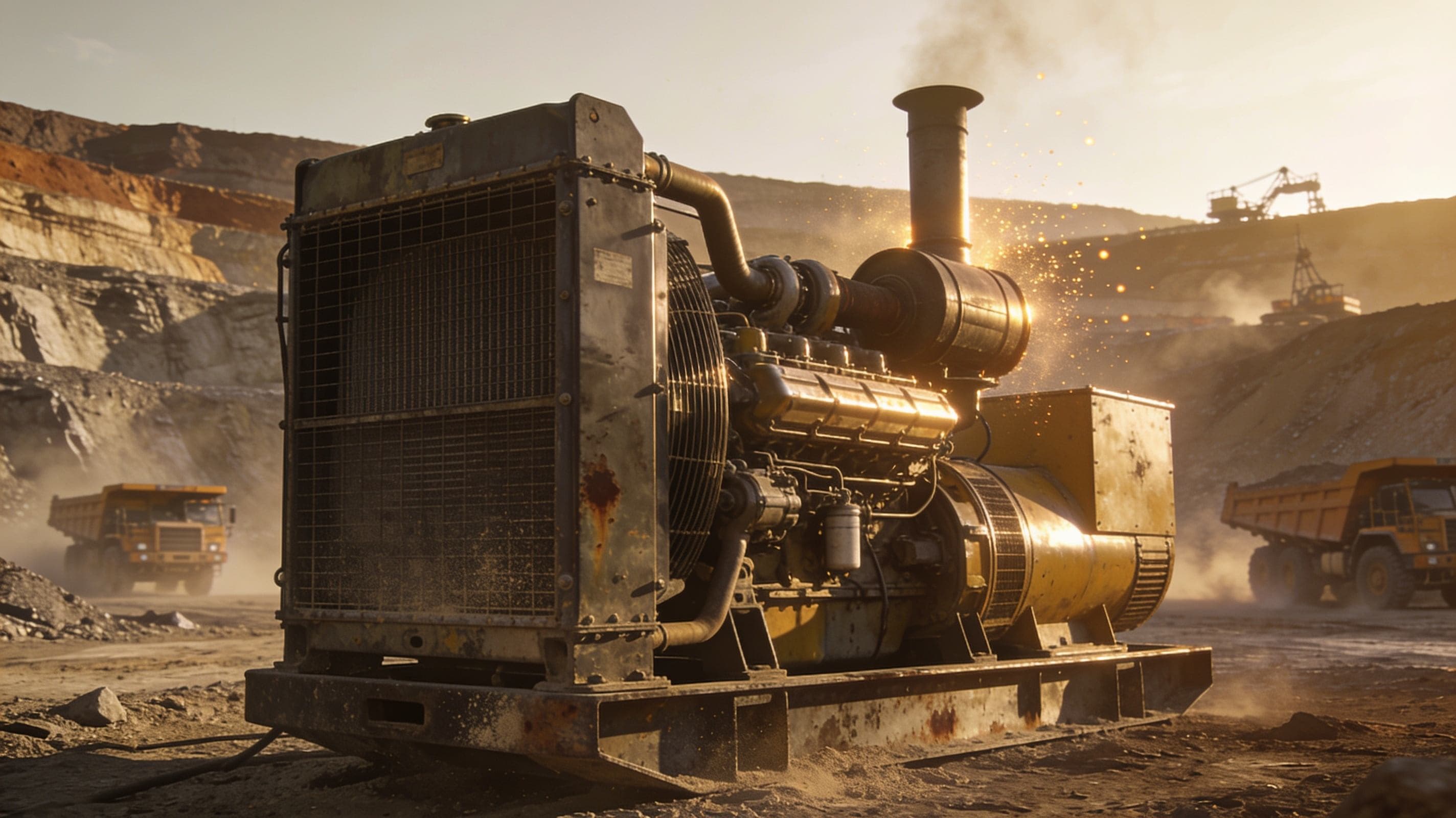
How to size a generator for a mine or quarry: apply altitude and ambient derating, size for prime duty and continuous load, and choose an enclosure that survives dust and remote service.
A quarry or mine above 2,000 m typically needs a set rated above the load you actually measure, because thin air and high ambient temperature both cut available output. Size for prime or continuous duty diesel generator sets, not standby, and plan for 24/7 running from the start rather than upgrading later.
Four constraints a mine puts on a set
Mining sites are among the hardest duty a generator set will ever see. Four constraints decide the build more than the nameplate kW does.
- Altitude and heat. Most hard-rock and many quarry sites sit between 1,000 m and 3,000 m, and ambient temperatures reach 40 to 50 °C in the season that matters most. Both reduce output, and together they can move you a whole power band.
- Dust and abrasive air. Crushers, drills and haul roads throw fine dust that clogs intake filters and wears cylinders. The set needs a heavy filtration path and a service interval matched to the site, not the catalogue.
- Continuous, not occasional, load. A mine runs the set as the primary source for long stretches, not just during outages. That is prime or continuous duty, with fuel burn at 75 percent load becoming a daily operating cost.
- Remote service. The nearest technician may be a day away. Spares, monitoring and a service plan matter more than they would for a town-site standby set.
Sizing step by step
Work the load first, then apply the site, then pick the band. Do not start from a catalogue kW and hope; use the full diesel range to find the band that actually covers the derated figure.
- 1List the running load. Add the steady process load (conveyors, pumps, ventilation, lighting) in kW, per phase where the supply is split.
- 2Add the largest motor to start. Jaw crushers, mills and big pumps have high starting current. The starting kVA, not the running kW, often sets the engine size.
- 3Apply duty. If the set carries the load whenever the grid is down or absent, specify prime or continuous. Standby ratings understate what a mine actually asks of the machine.
- 4Apply derating. Multiply the required output by the altitude and ambient factors for the site, then choose the band that covers the result with margin.
- 5Choose the build. Containerised sets with a dual-wall base tank and remote monitoring suit dusty, unattended sites better than an open skid.
Derating worked example
Use the same planning factors as the on-site calculator. The table below shows how an 800 kW usable requirement at altitude and heat translates to the nameplate you must buy.
| Site condition | Factor | Effect on an 800 kW requirement |
|---|---|---|
| Reference (sea level, 25 °C) | 1.00 | 800 kW nameplate covers it |
| 2,000 m altitude | 0.93 | 800 ÷ 0.93 = 860 kW nameplate needed |
| 2,000 m and 45 °C ambient | 0.93 × 0.99 = 0.9207 | 800 ÷ 0.9207 = 869 kW nameplate needed |
| 3,000 m and 45 °C ambient | 0.895 × 0.99 = 0.886 | 800 ÷ 0.886 = 903 kW nameplate needed |
So an 800 kW usable load at a 2,000 to 3,000 m mine with hot summers lands in the 800 to 1,200 kW band on the nameplate, not the 500 to 800 kW band you might pick from the running load alone. Size to the derated figure plus margin, never to the measured load.
The derating factors above are a planning guide. The engine manufacturer's published curve is the authority for the set you buy, and it should be on the datasheet and load-bank test report you receive before payment.
Which enclosure and fuel strategy
For a dusty, unattended site, the build matters as much as the engine. KINBOOST builds containerised sets with a dual-wall base tank and remote monitoring as standard, because that is what the duty demands. See the mine and quarry solutions page for the enclosure line-up, and the construction site guide for how mobile sets move with a moving work front.
- Containerised or heavy canopy. A weather- and dust-sealed enclosure with a proper filtration path keeps the set running between service visits. An open skid is cheaper but costs you downtime once dust gets in.
- Dual-wall base tank. Remote sites cannot rely on daily fuel delivery. A bunded base tank extends run time and contains spills.
- Remote monitoring. A controller with Modbus or dry-contact output lets your team watch fuel, runtime and faults from the office, so a small fault does not become a stopped crusher.
- Spares on site. Keep the filters, belts and consumables the dusty duty consumes most, and confirm lead time for the engine family you choose.
Questions buyers ask about mine-site sets
Frequently asked questions
Can a standby-rated set run 24/7 at a mine?
Not as rated. Standby sets are built and cooled for occasional use, and running them continuously voids the duty assumption behind the rating. For mine sites, specify prime or continuous duty so the cooling, service interval and warranty match the hours.
How much does altitude really take off?
Using the planning factors, 2,000 m costs about 7 percent and 3,000 m about 10 to 11 percent of output, before any temperature penalty. A hot site adds a further 1 to 2 percent. Always apply both, then add margin.
Do I need a bigger alternator for motor starting?
Often yes. Large crusher and pump motors draw several times running current at start, and the alternator and AVR must support that surge without the voltage collapsing. State the largest motor and its start method in the enquiry.
Open skid or container for a quarry?
Containerised for dusty, unattended or remote quarries; an open skid only where the set is sheltered and serviced on a known schedule. Dust is the deciding factor more often than noise.
How do I keep fuel from going bad at a remote site?
Size the base tank for realistic run time, keep it sealed and bunded, and plan a fuel quality check on the service interval. Long idle with partly filled tanks invites condensation and microbial growth.
Should I parallel two smaller sets instead of one large set?
For loads that grow or where redundancy matters, two paralleled sets give you N+1 and let one come down for service. It costs more up front and needs synchronising gear, so it pays off mainly above roughly 1,200 kW or where downtime is expensive.