How to Buy a Generator Set from China: The Buyer's Process from Enquiry to Commissioning
Buying a generator set from China is a process, not a product lookup. Send a real load list, read the quote by rated output not nameplate, witness the test, and confirm the documents before the container sails.
Buying a generator set from China works best as a process with checkpoints, not a one line enquiry. You send a load list and site conditions, you read the quote by rated output and rating, you witness or receive evidence of the load-bank test, and you confirm the clearance documents before the container leaves. The steps below are the same ones a professional buyer runs on every order.
Start with a load list, not a kilowatt number
A kilowatt figure alone tells a supplier almost nothing useful. The set has to start the largest motor, carry the running load, and hold up in your climate. Write down every load you will run, mark which start hardest (motors, compressors, lifts), and note whether the load is continuous or standby. A proper sizing pass turns that list into a rated output, and the generator sizing guide walks through the calculation with a worked example.
Put the site conditions in the enquiry
Two site facts move the specification more than anything else: altitude and ambient temperature. Both cut the power the engine can deliver, and the supplier must build the derate in at the quote stage, not apologise for it on site. Fuel type, duty cycle and the destination port belong in the same email.
| Condition | Why the supplier needs it |
|---|---|
| Altitude above sea level | Thin air lowers engine output; sets above 1000 m need a derate |
| Ambient temperature | Heat reduces output and stresses cooling; tropical sites need headroom |
| Fuel and duty | Diesel, gas or dual-fuel, and whether the set runs 24/7 or only on outage |
| Destination port | Decides Incoterm, clearance path and the documents required |
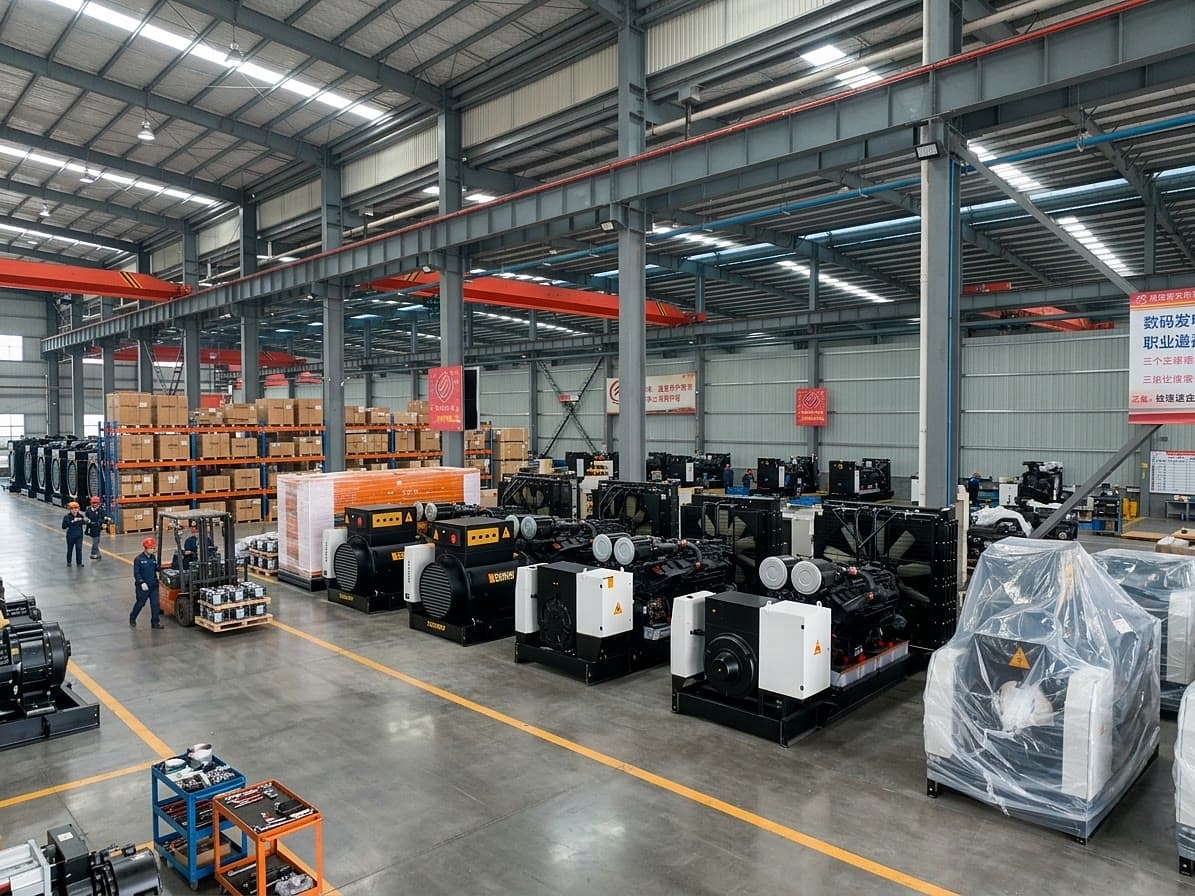
KINBOOST supplies diesel and gas sets built at the production floor in Weifang, rated 20 to 2000 kW, with Perkins, Cummins, Yuchai, Shangchai, Weichai and Changchai engine options and open, silent, mobile and containerised builds. The enquiry still has to state the load and the site; the build is matched to it.
Read the quote by rated output, not nameplate
A quote should state the prime or standby rating in kW and kVA, the rated voltage and frequency, and the derated output for your altitude and temperature. If the number shown is the engine nameplate with no site correction, the set will underperform the day it is hot or high. The kVA vs kW note explains why both numbers appear, and the derating guide shows how the correction is applied.
| Quote line | What it should show |
|---|---|
| Rating | Prime or standby in kW and kVA, with the ISO 8528 basis stated |
| Derate | Output after your altitude and ambient are applied |
| Alternator | Rated power factor and voltage regulation |
| Scope | What is included: base, radiator, controller, breakers |
Confirm the rating and the derate
Rating defines how long and how hard the set may run. Standby covers outage only, prime covers variable load, continuous covers steady load, and the ISO 8528 ratings guide sets out the differences with the load limits. Match the rating to the duty before you compare prices, because a standby set quoted against a prime duty is a different machine.
Ask for the test, not just the certificate
A certificate says the model was tested. A load-bank report says this serial number was tested, at the load, with the readings. Ask for a witnessed test or at least a video of the set on load with the controller screen visible, and read the report the way the load-bank report guide describes. KINBOOST can arrange a witnessed test at the Weifang works or a video call to the test cell before the set is crated.
A supplier tied to the works that builds the set can show you the line, the test cell and the serial number. That is the evidence a relabelled catalogue cannot provide, and it is the cheapest insurance against a set that only runs on paper.
Payment, inspection and Incoterms
Most orders run on a 30 percent deposit with the balance before loading, or a letter of credit at sight for larger buys. The Incoterm decides who owns the freight and the risk: EXW means you collect from the works, FOB means the supplier loads the ship, CIF means the supplier pays freight and insurance to your port. The lead time and payment note lays out the usual ranges and what shifts them.
| Term | Who carries the freight |
|---|---|
| EXW | Buyer collects from the works and arranges everything |
| FOB | Supplier delivers on board at the load port |
| CIF | Supplier pays freight and insurance to your port |
| CIP | Supplier pays freight and insurance to a named place |
Documents you must receive before the container sails
- Commercial invoice and packing list with weights and dimensions
- Bill of lading, made out to the correct party
- Certificate of origin where your market requires it
- Test report for the serial number, not just a model certificate
- Conformity documents for the destination (SONCAP, PVoC, SABER and so on)
Mistakes that cost buyers money
- Quoting on nameplate output with no derate for a high, hot site
- Buying standby rating for a prime duty and overloading it within a month
- Skipping the load-bank report and finding the fault on first outage
- Leaving conformity documents until after the container has sailed
- Choosing the cheapest Incoterm and discovering the freight was not insured
What KINBOOST supplies and how to verify it
KINBOOST is a Jinan based power company that supplies generator sets built at the Weifang production floor, covering sheet metal, painting, assembly and a full load test before the set leaves. The range runs 20 to 2000 kW in diesel and gas or dual-fuel, with the engine options named above and the four build forms. Office is in Jinan, the works are in Weifang, and sets ship from a nearby ocean port. Before you order, you can request the works video, a witnessed test, or a visit, and the about page shows the floor and the process. The request a quote page is where the load list goes.
None of the above replaces your own verification. Read the report, confirm the serial number, and check the destination conformity yourself or through your clearing agent. The set should arrive with evidence, not promises.
Frequently asked questions
Do I need a letter of credit to buy from China?
Not always. Many orders run on 30 percent deposit and 70 percent before loading by telegraphic transfer. A letter of credit at sight is common for larger first orders where both sides want a bank in the middle, and the payment note covers the usual terms.
Why is the load-bank test more useful than a certificate?
A certificate covers a model. A load-bank report covers your serial number at the load you will actually run. The report guide shows what to look for, and a witnessed test removes doubt before the crate is sealed.
How long does delivery take?
A built to spec set typically needs 15 to 35 days after deposit, longer for containerised or dual-fuel builds. The exact window depends on the engine brand and the build form, so confirm it against your order rather than a generic number.
What documents does my clearing agent need?
Invoice, packing list, bill of lading, certificate of origin where required, the serial number test report, and the conformity certificate for your market such as SONCAP, PVoC or SABER. Missing the conformity document is the most common reason a container is held.
Can I visit the works before ordering?
Yes. KINBOOST can arrange a visit to the Weifang production floor, a witnessed load-bank test, or a video call to the test cell. Seeing the line and the test is the most direct way to verify what you are buying.
Which rating should I specify?
Match the rating to the duty. Standby for outage only, prime for variable load, continuous for steady load, with the limits set by the ISO 8528 ratings guide. Specifying the wrong rating is the fastest way to overload a set.